
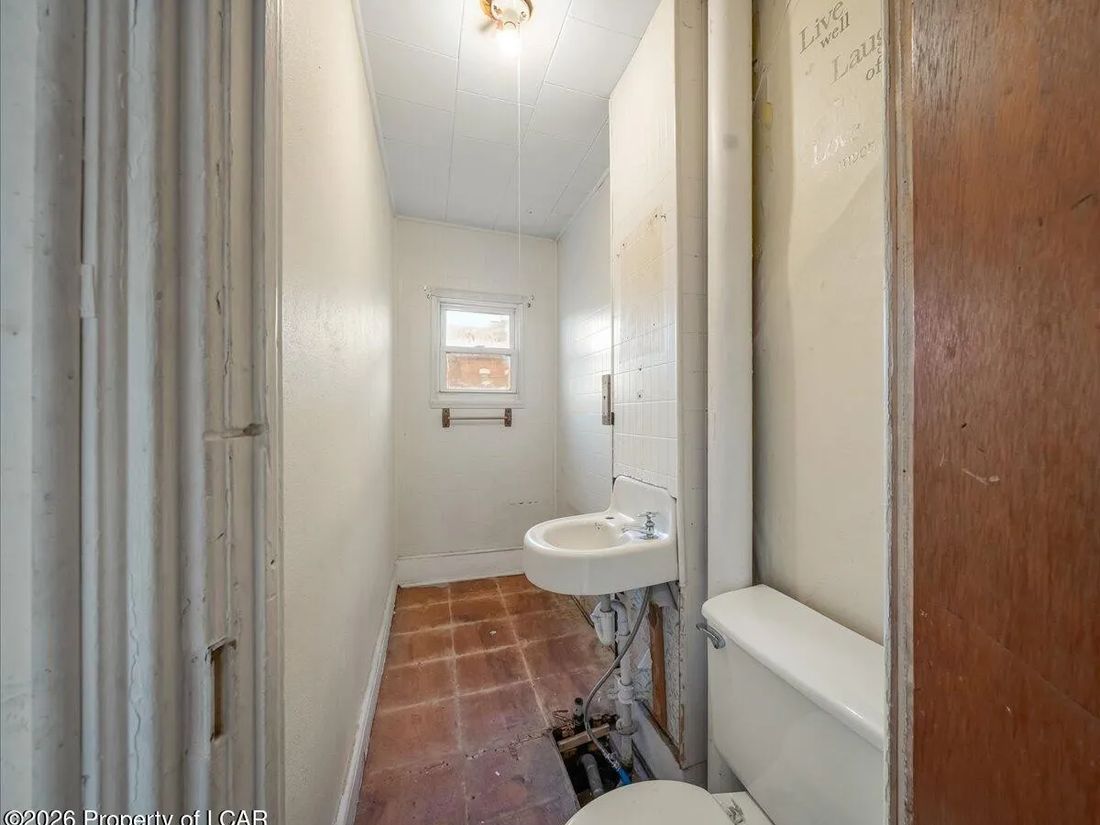
The home inspector's report came back with a line you did not expect: "Suspected asbestos-containing material observed on heating pipes in basement. Recommend evaluation by a qualified professional." Or maybe nobody has said the word yet, but you know the gray shingles on the side of the house are older than you are, the old boiler pipes in the cellar are wrapped in something white and chalky, and there is pebbly loose-fill insulation in the attic that your father put in decades ago.
In Scranton, Wilkes-Barre and the river towns between them, that is not unusual. A lot of the housing here went up when the region ran on anthracite: double-blocks and single homes heated by coal-fired boilers and steam or hot-water pipes, many later converted to oil or gas with the old piping left in place. Those are exactly the places asbestos tends to turn up. This guide covers what asbestos in a house actually means when you are selling, what Pennsylvania's disclosure form asks you, who is allowed to remove it, and the realistic ways to sell.
Asbestos in a house is common in older NEPA homes and does not stop a sale. You cannot tell by looking; only lab testing of a sample confirms it. Material in good condition that won't be disturbed is generally best left alone, according to the EPA. Pennsylvania's disclosure form asks whether you are aware of hazardous substances, asbestos by name, and whether the house has been tested. You are not required to test, but if you know, you disclose. Anyone you hire to remove it should be a Pennsylvania L&I-certified abatement contractor. Your options are to disclose and sell as it is, repair or encapsulate, remove it, or sell as-is to a cash buyer.
Where Asbestos Hides in Older Northeast PA Houses
Asbestos was used for decades in building materials because it resisted heat and fire. The EPA lists the places it is most often found in homes, and several of them describe a typical Lackawanna or Luzerne County house almost line for line:
- Hot water and steam pipes coated with asbestos material or wrapped in an asbestos blanket or tape. In a house that was once heated by a coal boiler, the old pipe runs in the basement are the first place an inspector looks.
- Oil and coal furnaces and their door gaskets with asbestos insulation. Old boilers that were never pulled out after a conversion still count.
- Roofing and siding shingles. Some older shingles are asbestos cement: hard, brittle, often with a dimpled or wood-grain texture.
- Vermiculite attic insulation. Covered in its own section below.
- Older floor tiles and their backing and adhesive, plus some textured ceilings and patching compounds.
None of that means your house has asbestos. It means those are the materials worth knowing about. The EPA is blunt on the key point: you generally can't tell whether a material contains asbestos just by looking at it, unless it is labeled. If you are in doubt, treat it as if it does and leave it alone.
The Attic Insulation Question: Vermiculite
Vermiculite is a pour-in, pebble-like insulation, usually gray-brown or silver-gold. According to the EPA, a mine near Libby, Montana, supplied more than 70 percent of all vermiculite sold in the United States from 1919 to 1990, and that mine also held an asbestos deposit. Much of it was sold under the brand name Zonolite.
The EPA's advice is unusual in that it tells homeowners not to bother testing: if you have vermiculite insulation, assume it contains asbestos and do not disturb it. The agency says further testing is not necessary to take the right precautions, that attic testing can be expensive and may give misleading results, and that you should not open walls to look for it. Don't store boxes on it, don't let kids play in that attic, and don't try to remove it yourself.
If you know vermiculite is in the attic, that is something you know about the house, and it goes on the disclosure form. You do not need a lab report to answer honestly: "vermiculite insulation in attic, not tested, assumed to possibly contain asbestos" is a clear, truthful disclosure that a buyer can price.
What Pennsylvania's Disclosure Form Asks You
Pennsylvania's Real Estate Seller Disclosure Law requires most sellers of homes with one to four units to give the buyer a property disclosure statement before the agreement of sale is signed. One of the subjects the statute requires the form to cover is the presence of hazardous substances. The State Real Estate Commission's form, at 49 Pa. Code § 35.335a, asks three questions in that section:
- Are you aware of any underground tanks or hazardous substances present on the property, in the structure or the soil, including asbestos, PCBs, radon, lead paint or urea-formaldehyde foam insulation?
- To your knowledge, has the property been tested for any hazardous substances?
- Do you know of any other environmental concerns that might affect the property?
Any "yes" needs an explanation. Two practical points follow from how those questions are worded:
- You are not required to go looking. The form asks what you are aware of and whether testing has been done. Nobody is obligated to cut a sample off their boiler pipes to fill it in. "Unknown" is a fair answer when it is honest.
- Once you know, you know. If a previous buyer's inspector flagged pipe wrap, a contractor told you the siding is asbestos cement, or you had a sample tested, that is knowledge. A deal that fell apart over it does not erase it. Disclose it, along with any test results and any work you had done.
"As-is" does not change this. As-is is a repair and pricing term, not a disclosure exemption. We explain who is and is not exempt, including executors selling an estate house, in what you must disclose when selling a house in Pennsylvania. It is the same logic as radon, which sits in the same section of the form; our radon guide for NEPA sellers walks through that one.
Inspector Flagged Asbestos?
Tell us what the report says. We buy older NEPA houses with asbestos pipe wrap, siding or vermiculite as-is, and we price it into the offer up front. No obligation, no fees.
Who Can Test and Remove Asbestos in Pennsylvania
Two state agencies are involved, and the split matters for homeowners.
The Department of Environmental Protection (DEP) enforces the federal asbestos air-pollution rules for demolition and renovation projects. DEP says plainly that it does not regulate asbestos removal from private residences unless the building is an apartment with five or more units, and it tells homeowners to check with their township or borough for any local rules. For a single-family house or a double-block, DEP is generally not the agency standing over the job.
The Department of Labor & Industry (L&I) runs the certification side under the Asbestos Occupations Accreditation and Certification Act (Act 194 of 1990). Under L&I's rules, people who perform asbestos removal must work for a contractor that holds current L&I certification, and L&I separately certifies asbestos inspectors. It publishes searchable lists of certified abatement contractors and of inspectors who do building inspections.
What that adds up to for a seller:
- Get testing done by a trained, accredited professional. The EPA warns that sampling done wrong can be more hazardous than leaving the material alone.
- If you hire removal, check the contractor against L&I's certified list before you sign. A buyer's agent or attorney will ask who did the work, and "a guy with a shop vac" is not an answer that helps your sale.
- Keep the paperwork. Lab results, the contractor's scope and invoice, and any clearance testing all go to the buyer with your disclosure.
The EPA's guidance is that asbestos material in good condition that won't be disturbed is not likely to pose a health risk, and that improper removal can actually increase your family's exposure. Tearing out pipe wrap or scraping old tiles the week before a showing turns a disclosure item into a real hazard.
Your Four Options When Selling
Which one makes sense depends on what the material is, what shape it is in, and how much time and money you want to put into the house before it sells.
1. Disclose it and sell the house as it is
For a lot of NEPA houses this is the simplest path. Intact asbestos-cement siding or a few runs of jacketed pipe are known quantities to experienced local buyers, and many will price them in rather than walk. Expect the buyer's inspector to flag it, and expect some buyers to ask for a credit.
2. Repair or encapsulate
The EPA describes two kinds of repair, both done by trained professionals. Encapsulation seals the material so fibers are not released; pipe, furnace and boiler insulation can sometimes be handled this way. Enclosure covers it, for example by wrapping exposed insulated piping in a protective jacket. In both cases the asbestos stays in the house, so it still gets disclosed, but a buyer sees a managed condition instead of a damaged one.
3. Have it removed
Removal makes sense when the material is badly damaged, or when it is somewhere a buyer will certainly disturb, like a basement they plan to finish. It is the most involved option, it has to be done by certified people, and it is worth getting more than one quote. If the house needs other major work too, weigh it the way we lay out in selling as-is versus renovating first.
4. Sell as-is to a cash buyer
If you don't want to test, fix or manage contractors at all, a cash buyer takes the house with the asbestos in it. You still fill out the disclosure form honestly. What changes is that the buyer is pricing the condition up front instead of discovering it during inspection and renegotiating. Our sell your house as-is in Scranton page explains how that works, and how cash offers are calculated in NEPA shows the math behind the number.
| Option | What you do before closing | Still disclosed? | Best fit |
|---|---|---|---|
| Disclose and sell | Nothing beyond the disclosure form | Yes | Intact siding or pipe wrap, financed buyers still interested |
| Encapsulate or enclose | Hire a trained professional to seal or cover it | Yes, with the work documented | Slightly damaged pipe or boiler insulation |
| Remove | Hire an L&I-certified abatement contractor | Yes, with the work documented | Badly damaged material or a buyer who will renovate |
| Sell as-is for cash | Nothing; the buyer prices it in | Yes | Estate houses, tired rentals, sellers short on time or cash |
Estate Houses, Rentals and Houses That Need Everything
Asbestos rarely shows up alone. The houses we see it in are usually older homes that also have a dated electrical panel, a wet basement or a roof near the end of its life, and quite often they are being sold by a family after a parent has died. If that is your situation, our guide to selling an inherited house in Scranton covers probate and inheritance tax, and the disclosure guide explains how the rules work for executors.
We bought a Wilkes-Barre two-unit out of an estate with the kind of older basement and finishes you see all over the Valley. The photo at the top of this article is from that house's basement. Older square floor tiles like those are one of the materials the EPA lists, and they are exactly the kind of thing to leave in place rather than chip up before a sale. The same goes for houses sitting over old mine workings, where mine subsidence is a second disclosure question layered on top.
How We Handle Asbestos When We Buy
We buy older houses across Scranton, Wilkes-Barre and the rest of Northeast Pennsylvania, and asbestos is a normal part of that. You don't have to test it, remove it or clean anything out before we make an offer. Tell us what you know, show us the inspection report if you have one, and we account for it in the price. If listing would net you more because the material is minor and in good shape, we will tell you that too; our comparison of selling options lays the two side by side. More common questions are on our FAQ page, or call (570) 433-9191.
This article is general information about Pennsylvania real estate disclosure and asbestos rules and is not legal, medical or environmental advice. Regulations change; confirm your situation with a Pennsylvania real estate attorney, and use a trained, accredited asbestos professional for any sampling, repair or removal.