
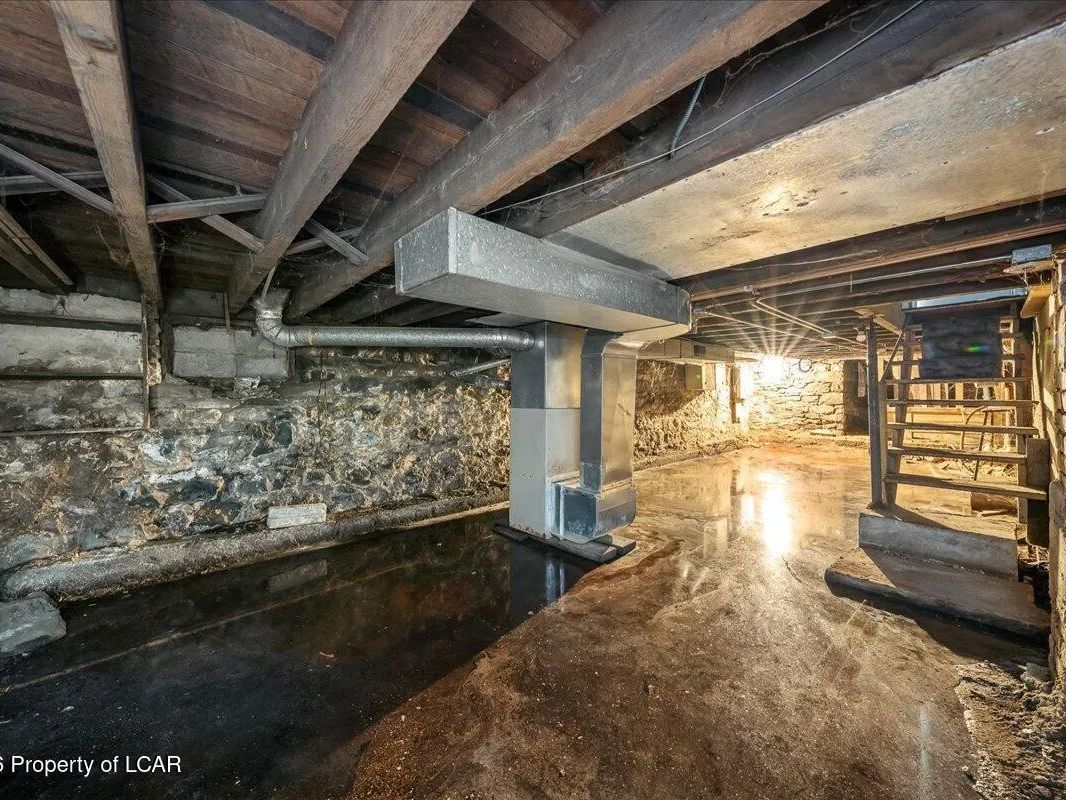
There is a conversation we have several times a year in Lackawanna and Luzerne counties, and it always starts the same way. A homeowner noticed a crack. Not a hairline crack in the drywall — a stair-step crack running diagonally through the block or stone in the basement wall, or a door upstairs that stopped latching, or a corner of the porch that pulled away from the house over one winter. Somebody, usually a neighbor or an uncle, said the words mine subsidence. And now the seller is trying to work out two things at once: what is actually happening under the house, and whether it just cost them their sale.
This guide answers the second question honestly, and gives you the free tools to answer the first. Northeast Pennsylvania is one of the few places in the country where "is my house over a mine?" is a normal question with a real, checkable answer — and where the state runs an insurance program specifically because the private market won't.
Mine subsidence is a known, mapped, insurable condition in the anthracite region, not a mystery. You can check your address for free in about five minutes. Standard homeowners policies generally do not cover it — Pennsylvania's DEP sells the coverage instead. And you are required to disclose what you know, not to go investigate. Most of the damage sellers do to their own sale comes from guessing, not from the ground.
What Mine Subsidence Actually Is — and Why NEPA Is Different
Subsidence is what happens when the ground surface moves downward because underground mine workings beneath it give way. In our part of the state those workings are anthracite — the Lackawanna Valley and the Wyoming Valley were mined intensively from the mid-1800s through the middle of the twentieth century, and a great deal of the housing stock in Scranton, Dunmore, Carbondale, Pittston, Wilkes-Barre, Kingston and Nanticoke was built on top of, or immediately beside, those workings. Much of that housing went up between roughly 1880 and 1950, which is to say it was built before anyone was thinking about what the mine below would do eighty years later.
The Pennsylvania DEP describes the covered event in two forms: the collapse of underground coal or clay mine workings, and a sudden, unexpected breakout of water from an abandoned mine. The second one surprises people. Mine pools do not stay put, and a breakout can flood a basement that never took water before.
Two things it is not, and both matter when you're filling out paperwork:
- It is not ordinary settlement. A century-old house on a stone foundation settles. Mortar deteriorates, sills sag, a floor develops a slope. That is the normal aging of NEPA housing stock and it is not subsidence.
- It is not a limestone sinkhole. Those are a different geology and a different problem — and DEP's mine subsidence coverage specifically does not apply to sinkholes that occur as a result of limestone weathering. If you're in the Lehigh Valley that distinction is your whole problem; in the anthracite counties it usually isn't.
The practical consequence of living over the Northern Anthracite Field is simply this: a condition that would be an exotic surprise in most housing markets is a routine, well-documented one here, with a state agency, a mapping tool and an insurance fund attached to it. That is genuinely good news for a seller who uses it.
The Signs Sellers Around Scranton and Wilkes-Barre Actually See
Almost nobody discovers subsidence dramatically. What sellers describe to us is a slow accumulation of small wrongnesses:
- Stair-step cracking through block, brick or stone in the foundation — the mortar joints separating in a diagonal staircase pattern rather than a single straight line.
- Doors and windows that used to work and now bind, stick or won't latch, usually concentrated on one side of the house.
- A floor that slopes consistently in one direction, rather than the general unevenness an old house has everywhere.
- Separation where an addition, porch or garage meets the main structure.
- New cracking in a driveway, sidewalk or retaining wall, or a shallow depression that appears in the yard and slowly deepens.
- Basement water that changes character — a dry basement that starts taking water, or a wet one whose water arrives from a new place.
Here is the honest part: none of that proves mine subsidence. Every single item on that list also happens to hundred-year-old houses with a failed downspout, a clogged perimeter drain, a rotted sill or a tree root. We bought a Wilkes-Barre double where standing water in the basement was one of several problems on the table, and the water had nothing to do with the mines. Symptoms overlap. That's exactly why guessing is the expensive move.
The two ways sellers hurt themselves here are opposite and equally avoidable. One is writing "mine subsidence" on a disclosure form because a neighbor said so, permanently attaching a structural claim to the property that may not be true. The other is answering "no" to the earth-movement question while the basement wall is visibly stepping apart. Describe what you have observed — "diagonal cracking in the north foundation wall, first noticed spring 2024" — and let the buyer's inspector characterize it. Observation is always safe. Diagnosis rarely is.
How to Find Out Whether Your House Sits Over a Mine
You can answer this yourself, for free, without hiring anyone and without committing to anything. Pennsylvania maintains three separate resources:
- The MSI Risk mapping application. DEP's interactive map lets you locate a site by street address, by latitude and longitude, or by municipality. Once the site is located, it reports the mining conditions beneath it and whether Mine Subsidence Insurance is recommended for that address. It's at gis.dep.pa.gov/MSIRisk.
- The MSI Site-Specific Request Form. If you want something in writing tied to your parcel rather than a screen you looked at once, DEP takes a written request for information about underground mining at your location. This is the version worth having in a file if you expect a buyer's lender or insurer to ask questions.
- The Pennsylvania Mine Map Atlas. A joint DEP and Penn State project that publishes georeferenced historical underground mine maps online, at minemaps.psu.edu. These are the actual old workings maps, overlaid on aerial and topographic imagery.
Or skip the internet entirely and call DEP's Mine Subsidence Insurance line at 1-800-922-1678. The same number handles applications and claims.
The Mine Map Atlas states plainly that its data was created using georeferenced mine maps "of various/unknown accuracy and various/unknown coordinate systems," and that users assume the entire risk as to quality and performance. Nineteenth-century mine maps were drawn by people with lanterns and chains. Treat the atlas as strong evidence about the neighborhood and weaker evidence about your specific property line — which is exactly why the site-specific request form exists.
Mine Subsidence Insurance: What It Covers and What It Costs
The reason Pennsylvania runs this program at all is that damage from mine subsidence and mine water breakouts is usually not covered by a standard homeowners policy. Homeowners find that out at the worst possible moment. DEP sells the coverage directly through the Coal and Clay Mine Subsidence Insurance Fund, and by insurance standards it is inexpensive.
| Question | What DEP Says |
|---|---|
| Who can buy it | Any homeowner whose property sits on top of an abandoned coal or clay mine. Adjacent properties may also be at risk. |
| Coverage range | $5,000 up to $1,000,000. DEP suggests insuring for replacement value plus 20%. |
| Cost | About 27 cents per $1,000 of residential coverage per year — an average $160,000 policy runs roughly $43.75 a year, about $3.65 a month. |
| What it covers | Damage to your home and buildings from the collapse of underground coal or clay mine workings, or from a sudden unexpected breakout of water from an abandoned mine. |
| Appurtenances | Fences, retaining walls, driveways and pools are included, but capped at 10% of the coverage amount. |
| Incidental costs | Between $600 and $7,000 toward things like temporary relocation and increased utilities, depending on the severity of the loss. |
| Not covered | Personal belongings, and sinkholes that occur as a result of limestone weathering. |
| Applying / claims | Apply online through DEP or call 1-800-922-1678. Claims are filed with a DEP field office and investigated by the MSI Fund. |
Full details are on the Commonwealth's Mine Subsidence Insurance page.
The single most important line in that table for a seller is the one nobody reads until closing week: your policy does not travel with the house. DEP's answer is direct — the new owners need to apply for their own policy. If you carry MSI, treat that as a talking point rather than a landmine. Tell the buyer up front, hand them the phone number, and let them get their own coverage lined up while the contract is still young.
What You Actually Have to Tell a Buyer
Pennsylvania's Real Estate Seller Disclosure Law, at 68 Pa.C.S. § 7301 and the sections that follow, requires you to disclose material defects you know about, on the statutory form, before the agreement of sale is signed. The contents of that form are set by regulation at 49 Pa. Code § 35.335a, and it puts the question to you plainly: are you aware of any sliding, settling, earth movement, upheaval, subsidence or earth stability problems affecting the property? Have sinkholes developed? Is there existing or proposed mining or excavation nearby?
The governing word is known. Pennsylvania does not make you investigate. If you have never pulled the MSI Risk map and have never seen movement, "unknown" is an honest answer and a legitimate one. What the law does not tolerate is a seller answering "no" to a question they know the real answer to — and a subsidence claim you filed in 2011, an engineer's letter you commissioned and set aside, or a repair you paid for are all things you know. Disclose the claim and the repair. A documented, remediated problem reads very differently to a buyer than a discovered, concealed one.
We've written the whole disclosure picture up separately — the seventeen areas the form covers, who is genuinely exempt, and why an as-is clause does less legal work than sellers expect — in our guide to what you must disclose when selling a house in Pennsylvania. There are shorter answers to the questions that come up most on our FAQ page.
What Subsidence Does to a Retail Sale
Let's be even-handed about this, because plenty of NEPA houses with subsidence history sell perfectly well on the open market and it would be dishonest to suggest otherwise.
What changes is the shape of the transaction. A retail buyer using a mortgage brings a home inspector. Visible structural movement in the basement generally sends that inspector's report to a structural engineer, and the engineer's report generates a repair estimate, and the repair estimate generates a renegotiation. Buyers ask their insurance agent about coverage and discover the homeowners policy excludes it, which sends them to DEP and adds days. What was a 30-day contract becomes 45 or 60. Sometimes the buyer walks — not because the number was wrong, but because the uncertainty outlasted their patience.
The sellers who do well going this route are the ones who front-load the work: pull the MSI Risk report, get an engineer's assessment before listing rather than in response to an inspection, price the house with the findings in hand, and hand a buyer a folder instead of a surprise. That costs money and several weeks up front, and if you have both, it's often the right trade. Our 2026 Scranton market breakdown and our side-by-side of selling options lay out what a retail sale looks like on time and net proceeds in this market.
The problem was never the crack in the wall. It was the sixty days of uncertainty the crack created.
— what NEPA sellers actually describe to usYour Three Real Options
Strip away the noise and there are three, and the right one depends far more on your timeline and your appetite for uncertainty than on the severity of the movement.
| Option | What It Costs You | Who It Suits |
|---|---|---|
| Investigate and repair first, then list | Engineer's assessment plus structural repair, paid up front, plus weeks or months before the house goes on the market | Sellers with time, cash on hand, and a house whose after-repair value clearly justifies the spend |
| List as-is and disclose fully | No repair spend, but a longer contract, likely renegotiation after inspection, and real risk of a financing or insurance snag | Sellers who can absorb a slower, less certain close in exchange for a shot at retail pricing |
| Sell as-is to a cash buyer | A price that reflects the condition — but no repairs, no engineer, no commissions, no post-inspection renegotiation | Sellers who need a date certain, or who are managing an estate, a move, or a house they can't keep pouring money into |
We walk through the repair-versus-sell arithmetic in more detail in sell as-is or renovate first in Scranton, and if you want to see exactly how condition turns into a number rather than a mystery, how cash buyers calculate offers in NEPA shows the math line by line.
Not Sure What the Ground Under Your House Is Doing?
Tell us what you're seeing. We'll give you a straight read and a cash offer within 24 hours — no engineer's report required, no repairs, no fees.
Selling As-Is to a Buyer Who Already Knows the Ground
We know this ground. Frank and Larry have been buying in Northeast Pennsylvania since 2022, and the anthracite counties are not an exotic market to us — they are the market. We buy in Scranton, Wilkes-Barre, Carbondale, Pittston and the boroughs in between, and we have bought houses in every condition the region produces: century-old foundations, knob-and-tube wiring, water in the basement, and yes, houses with subsidence history and active signs of movement.
What that means practically is that the condition is priced in once, at the front, by someone who isn't guessing at it. There is no lender to spook, no appraisal to come in short, and no inspection report arriving on day 21 to reopen a settled number. You do not repair anything, you do not commission a study, and you do not clean out the basement. If the roof is bad and the north wall is stepping apart, tell us — it changes the number, not the answer.
The full process from first phone call to closing table is laid out on How It Works. Or just call (570) 433-9191 and describe what the house is doing. Even if the honest answer turns out to be "get an engineer and list it retail," you'll know where you stand — and that conversation costs you nothing.
This article is general information about Pennsylvania law and the Commonwealth's Mine Subsidence Insurance program, not legal, engineering or insurance advice. Coverage terms, rates and disclosure obligations turn on your specific property and transaction. Confirm coverage details with DEP at 1-800-922-1678, and speak with a licensed Pennsylvania real estate attorney or a structural engineer about your situation.